CAZyme Suite — how to use it & what it tells you
A connected set of pages for exploring carbohydrate-active enzymes (CAZymes), gene
neighbourhoods, and metabolic reactions across the 8 Syntrophomonas genomes. Every page is
keyed to the same protein identifier (gbid), so you can hop between a protein's domain
architecture, its operon, its counterparts in the other genomes, and the reactions it may catalyse.
The four pages
Per genome — every CAZyme protein as a length-scaled track of coloured domains, with a sortable hit table.
Per genome — putative operons (co-oriented neighbouring genes), drawn as gene-arrow clusters.
One protein — its domains, its operon, and the same-architecture proteins in the other 7 genomes.
One gene or an operon — the KEGG reactions & pathways it could carry out, as a list and a network sketch.
How they connect — everything hangs off one protein key (
gbid):
Domain architecture (browse a genome) → click a protein →
Gene / protein (drill in, compare across genomes) → its Operon →
Reaction activity (what the cluster does).
You can also arrive from a BLAST hit in the
Profiler / Search page or
from the
Active Sites page — both now link straight to the Gene page for the 8 genomes.
1 · Domain architecture /dbcan/?genome=N
- How to use
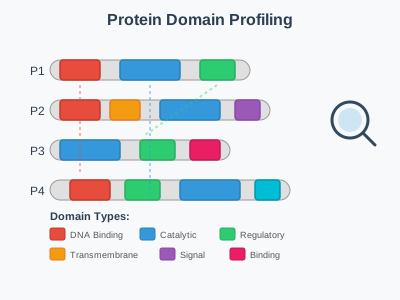
- Pick a genome from the switcher. Each CAZyme protein is one horizontal track; each coloured block is a domain at its position along the protein. Click a block for its family, e-value, score, and EC. Sort the hit table by any column.
- What it tells you
- The domain architecture of each enzyme — which CAZyme families it carries and in what order. Multi-domain proteins and repeated domains become obvious in a way a plain gene list can't show.
Domain groups:
GH glycoside hydrolase
GT glycosyltransferase
CE carbohydrate esterase
PL polysaccharide lyase
CBM binding module
SLH S-layer
AA auxiliary
cohesin
2 · Operons / gene clusters /dbcan/operons.php?genome=N
- How to use
- Pick a genome. Each card is a run of consecutive genes on the same contig and strand with small intergenic gaps — a putative operon. Adjust the gap threshold to merge or split clusters. CAZyme genes are coloured by group; neighbours are grey. Click a gene arrow for its detail (with links to its Gene page, Activity, and browser).
- What it tells you
- Which CAZyme genes sit together and are likely co-transcribed — i.e. function as a unit. This is the multi-protein "enzyme system" that the Reaction Activity page summarises.
An operon here is inferred from gene arrangement only (same contig + strand + gap ≤ threshold). It is a hypothesis to investigate, not an experimentally confirmed transcript.
3 · Gene / protein page /dbcan/gene.php?gbid=N
- How to use
- Search a locus id (e.g.
Sesp_00193) or arrive by clicking a protein anywhere in the suite. Four sections: identity/position, the domain-architecture track (CAZyme + Pfam, with signal-peptide / transmembrane markers), its operon, and the cross-organism comparison.
- What it tells you
- Everything about one protein in one place — and, crucially, its counterparts in the other genomes: every protein that shares the same Pfam-domain signature is listed, so you can see whether an enzyme is conserved across the 8 Syntrophomonas or unique to one. Each match links to its own Gene page.
▸ Try it: open an example gene
4 · Reaction activity /dbcan/activity.php?gbid=N or ?gbids=a,b,c
- How to use
- Open it for a single gene, or for a whole operon via the "reaction activity →" link on the Operons / Gene pages. Reactions are grouped by KEGG pathway (broad "overview" maps are demoted). Below, a reaction-network sketch: compounds are nodes, reactions are links labelled by gene. Drag nodes to rearrange; tick show cofactors to add H₂O/ATP/NAD⁺ etc.; click a link for the reaction equation.
- What it tells you
- The biochemistry a gene or gene cluster could perform — which reactions, in which pathways, and how the compounds chain together. For an operon, it answers "what overall metabolic activity might this cluster carry out?"
Reaction annotations come from KEGG orthology (eggNOG-assigned KOs → KEGG reactions). About half of each proteome carries a KO — genes without one simply show no reaction. Cofactors are hidden by default so the carbon backbone is visible rather than a hairball.
A typical workflow
Start broad — open
Domain architecture for a genome to see which proteins carry which CAZyme domains.
Drill into one enzyme — click a protein to reach its
Gene page; read its domain layout and check whether the other genomes have the same architecture.
See its context — the Gene page shows the protein's operon; or browse all operons for the genome on the
Operons page.
Ask what it does — follow "reaction activity →" to the
Activity page for the gene or the whole operon, and read the pathways and reaction network.
A note on the 8 genomes
This suite covers the eight Syntrophomonas genomes that have full dbCAN CAZyme annotation:
S. wolfei Goettingen (Swg), S. wolfei methylbutyratica 4J5 (Swm), S. curvata (Scur),
S. erecta (Ser), S. erecta sporosyntropha (Sesp), S. wolfei saponavida (Sws),
S. palmitatica (Spalm), and S. zehnderi (Szeh). Locus prefixes (Swg_, Sesp_, …) identify the genome at a glance.